
FAQ
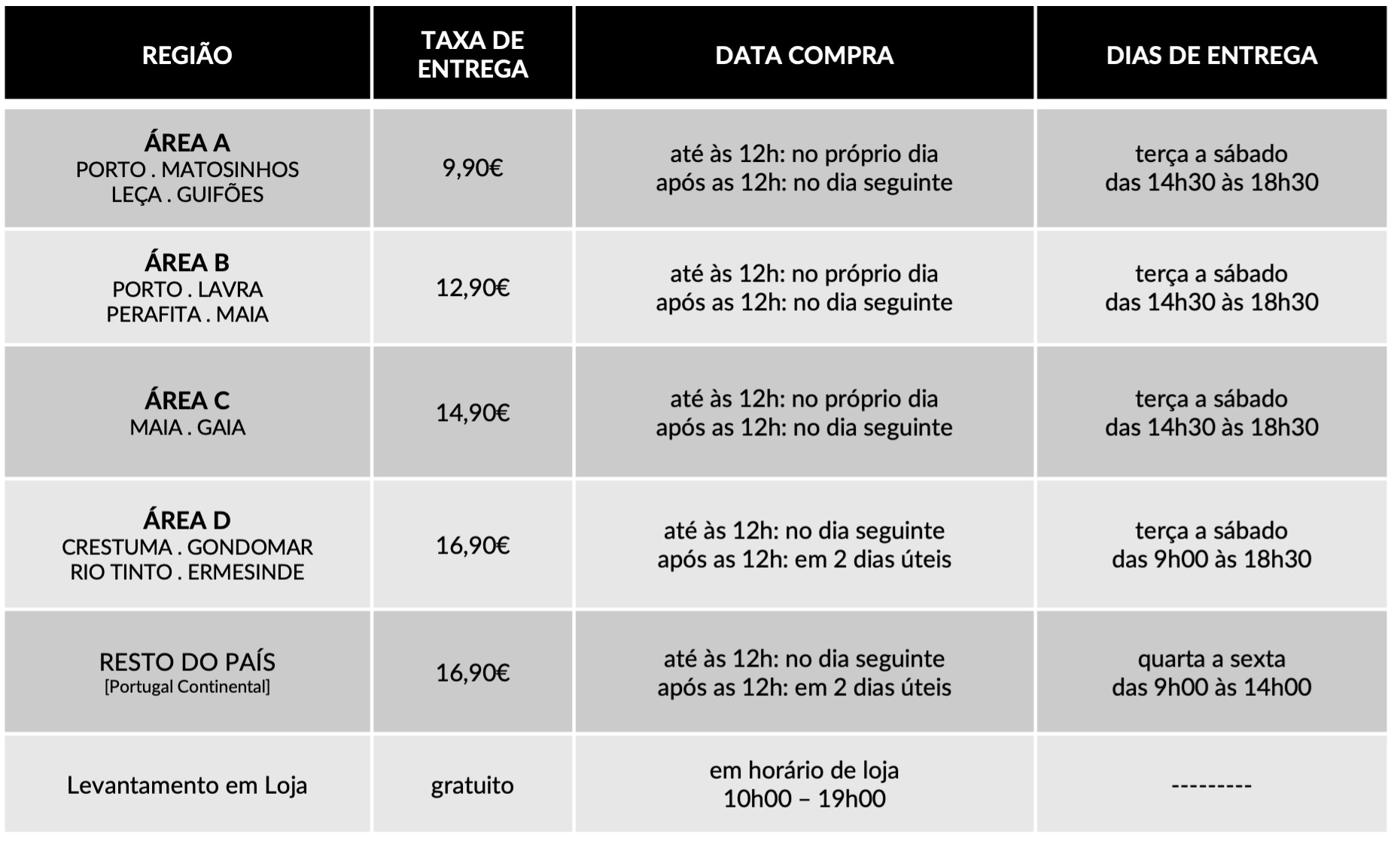
Dedicamos toda a atenção na manutenção e preservação das nossas Flores, garantindo que cheguem ao nosso cliente com toda a frescura, qualidade e beleza. Disponibilizamos várias soluções de manutenção e embalamentos adequando sempre a cada necessidade e contexto da entrega.
Pode incluir na sua oferta uma mensagem personalizada que irá ser reproduzida por nós. No processo da compra online basta preencher o campo ”dedicatória” e escrever a mensagem pretendida.
Valorizamos e priorizamos a qualidade dos serviços e dos nossos produtos. Todas as flores disponibilizadas nos ramos e arranjos disponíveis na loja online são frescas e estão em condições de servir o destinatário.
Caso haja alguma insatisfação por parte do cliente, recomendamos que utilize os nossos canais de comunicação para que possamos analisar a questão.
As fotografias são ilustrativas, quer isto dizer que não garantimos a 100% a sua fieldade com a realidade.
As fotografias devem ser interpretadas como uma base de modelo ou de estética onde as alterações estão sujeitas ao stock da flor e ao trabalho humano de cada florista. Note-se que algumas flores são sazonais e não estão disponíveis todo o ano. Como tal, serão necessárias fazer adaptações consoante a época e o stock da flor.
Para casos onde as alterações sejam extremamente notórias, contactaremos o cliente para ajustar a melhor solução.
Não cancelamos nem alteramos encomendas se esta já se encontrar em fase de curso, ou seja, se já tiver saído da loja e em fase de transporte.
Se a encomenda se encontrar no estado inicial, de processo, é possível alterar e cancelar a encomenda e reaver o seu dinheiro.
Caso não havendo outra referência dada pelo utilizador (por exemplo: deixar no porteiro, na loja x, à pessoa y) o utilizador será contactado de imediato para ficar ao corrente da situação e, à falta de alternativas, a encomenda voltará para a Terrárea, Caso seja reagendada uma nova entrega será cobrada novamente taxa de entrega.
Sublinhamos a importância dos dados fornecidos pelo utilizador estarem correctos e claros. Há sempre a possibilidade do utilizador acrescentar um ponto de referência e outras informações para que não hajam quaisquer dúvidas no acto da entrega garantindo, assim, a qualidade do serviço.
Lamentamos mas não podemos facultar essa informação, se o cliente que realizou a encomenda não pretender.
Estamos abertos a alterações embora estas estejam sempre condicionadas pelo tipo de pedido do utilizador, stock em loja e conceito estético. Nestes casos sugerimos o contacto telefónico ou por email.
Queremos satisfazer todos os nossos clientes e oferecer o nosso melhor serviço. Agradecemos, por isso, todas as opiniões e sugestões para podermos encontrar soluções às suas necessidades! Contacte-nos a partir dos seguintes meios: via email info@terrarea.pt ou telefone 223 170 414

Why Perpetuals on DEXs Are Different — And How to Trade Them Like a Pro
Okay, so check this out—perpetual futures used to live on centralized platforms. Now they’re migrating on-chain. Crazy, right? My first impression was simple: decentralization should be cleaner. But then I opened a position and got reminded that it’s still trading. Lots can go sideways. Somethin’ about that tension stuck with me.
Perpetuals are mechanically simple but behaviorally complex. You can hold a position forever, provided you pay or receive funding and avoid liquidation. That sounds neat. But the on-chain world layers new dynamics: AMM design, liquidity fragmentation, gas friction, and oracle cadence. Initially I thought “just copy CeFi models,” but that misses how on-chain settlement, counterparty risk reduction, and MEV interplay change the game. Actually, wait—let me rephrase that: the core math is familiar, though the environment changes your edge.
Whoa! Quick gut reaction: if you treat DEX perpetuals like spot trading with leverage, you’ll get burned. Seriously. Leverage multiplies not only profits, but frictions and fees. My instinct said: size down. On one hand, the ability to self-custody and use composable liquidity is empowering. On the other hand, fragmented liquidity increases slippage and execution risk, which is a hidden tax on leveraged positions.
Here’s the thing. Trading perpetuals on a DEX demands three intertwined skills: market read (what’s the flow?), execution (how to get in/out cheaply), and risk engineering (how to survive tail events). All three matter equally. If one breaks, your P&L suffers. So let’s walk through the practical parts—what I look for, what I avoid, and how to manage leverage like someone who’s been through the blowups.
How Perpetual Mechanics Differ on Decentralized Exchanges
Funding rates still balance longs and shorts. They reward one side and charge the other to anchor the contract price to the index price. But on-chain, the cadence of funding, oracle update frequency, and how funding is distributed (to stakers vs. liquidity providers vs. traders) vary. That nuance matters. If funding updates every block, arbitrage behaves differently than a once-per-8-hour cadence.
AMM-based perpetuals (versus order-book DEXs) add path-dependent slippage. A trade moves the virtual price on the curve, which changes margin and liquidation thresholds mid-execution. Hmm… that can make liquidations cascade faster than you’d expect. So you should treat large entries as execution problems, not just directional bets. Tools like TWAP execution, splitting orders, or using on-chain routers can reduce realized slippage.
Liquidity is king. Deep, well-distributed liquidity reduces sandwich risk and slippage, and buffers liquidations. But deep liquidity on-chain is expensive in capital terms. Some protocols subsidize it (via incentives) or aggregate from cross-chain sources. Look for protocol-level safety features: robust insurance funds, conservative oracle designs (time-weighted, multi-source), and reliable liquidation mechanisms.
Sizing, Leverage, and the Psychology of Liquidations
I’ll be honest—this part bugs me. People pick arbitrary leverage like picking a filter on social media. Don’t do that. Leverage should match your edge, your stop logic, and worst-case realized slippage. Here’s a mental model I use: assume the market can move 3x your ordinary volatility during a stress window. Then size to survive that move. Simple, but effective.
Liquidation is blunt and often unavoidable in volatile markets. On a DEX, being liquidated also means paying protocol fees and sometimes incurring on-chain MEV. That double-hit hurts. So plan exits ahead. Have pre-signed transactions? On-chain gas and mempool realities make that tricky, (oh, and by the way… frontrunning exists). Use collateral across positions conservatively, and avoid maxing margin on thinly traded pairings.
Risk work: set clear risk per trade like 0.5–2% of your portfolio, then back-calculate leverage from your stop distance. This is boring but it keeps you in the game. Also consider asymmetric sizing—smaller on illiquid underlyings, larger on high-volume markets.
Execution: Slippage, MEV, and Order Routing
Execution matters more when leverage is high. A 0.5% slippage on a 10x position is equivalent to a 5% P&L move. So you need to trade smarter. Use limit orders where available. If not, break entries into smaller tranches and use routers that minimize path-dependent slippage. Really think like an execution trader—reduce footprint, disguise intent, and avoid being predictable.
MEV and sandwich risks are real. Some DEXs mitigate this with private mempools or batch auctions. Others rely on liquidity depth to make sandwiches uneconomical. Check the protocol’s mitigation strategies. If that’s unclear, assume a cost and widen your stop accordingly. My working rule: if you can’t quantify execution friction, assume it’s material.
Funding Rate Strategies and Carry Trades
Funding can be an income source or a cost center. When funding is persistently positive, longs pay shorts, and vice versa. Professional traders use funding to design carry trades—long spot, short perpetual (or the inverse)—to capture funding while maintaining directional neutrality. That gets technical, but the intuition is simple: you earn payment by being the side that helps re-anchor prices.
Watch for funding regime shifts. News, liquidations, or sudden oracle moves can flip funding quickly. Time your carry exposures and size them so that a funding flip doesn’t trigger liquidation. Also, on-chain funding distribution mechanics differ—some platforms distribute to liquidity providers or stakers, which changes the effective carry you receive.
Choosing a DEX for Perpetuals: Checklist
I’m biased toward protocols that are transparent and battle-tested. Look for these features:
One platform I’ve used and that stands out for these traits is hyperliquid dex. Their UX and liquidity profiles make large-ish perpetual trades cleaner, and their documentation is pragmatic. I’m not endorsing them blindly—do your own due diligence—but they illustrate the level of polish you should look for.
Practical Checklist Before Opening a Levered Perp
– Confirm index price sources and oracle cadence.
– Estimate worst-case slippage and add a buffer.
– Pre-calc liquidation price under realistic fees.
– Decide position sizing by risk-per-trade, not charisma.
– Have an exit plan and gas strategy. (Yes, that last one matters.)
FAQ
What exactly is a perpetual contract?
A perpetual mirrors futures but without expiry. Traders pay or receive funding to keep prices in line with the index price. You can hold indefinitely as long as margin covers mark-to-market and funding costs.
How do funding rates affect my trade?
Funding is a periodic payment between long and short holders. If funding is positive, longs pay shorts; if negative, shorts pay longs. Over time, persistent funding becomes a cost or income stream and should factor into position P&L and sizing.
How do I avoid getting liquidated on-chain?
Use conservative sizing, account for slippage and funding, keep spare collateral, and prefer platforms with predictable liquidation mechanics. Also, don’t ignore gas—during volatility, getting out quickly can cost more than you expect.